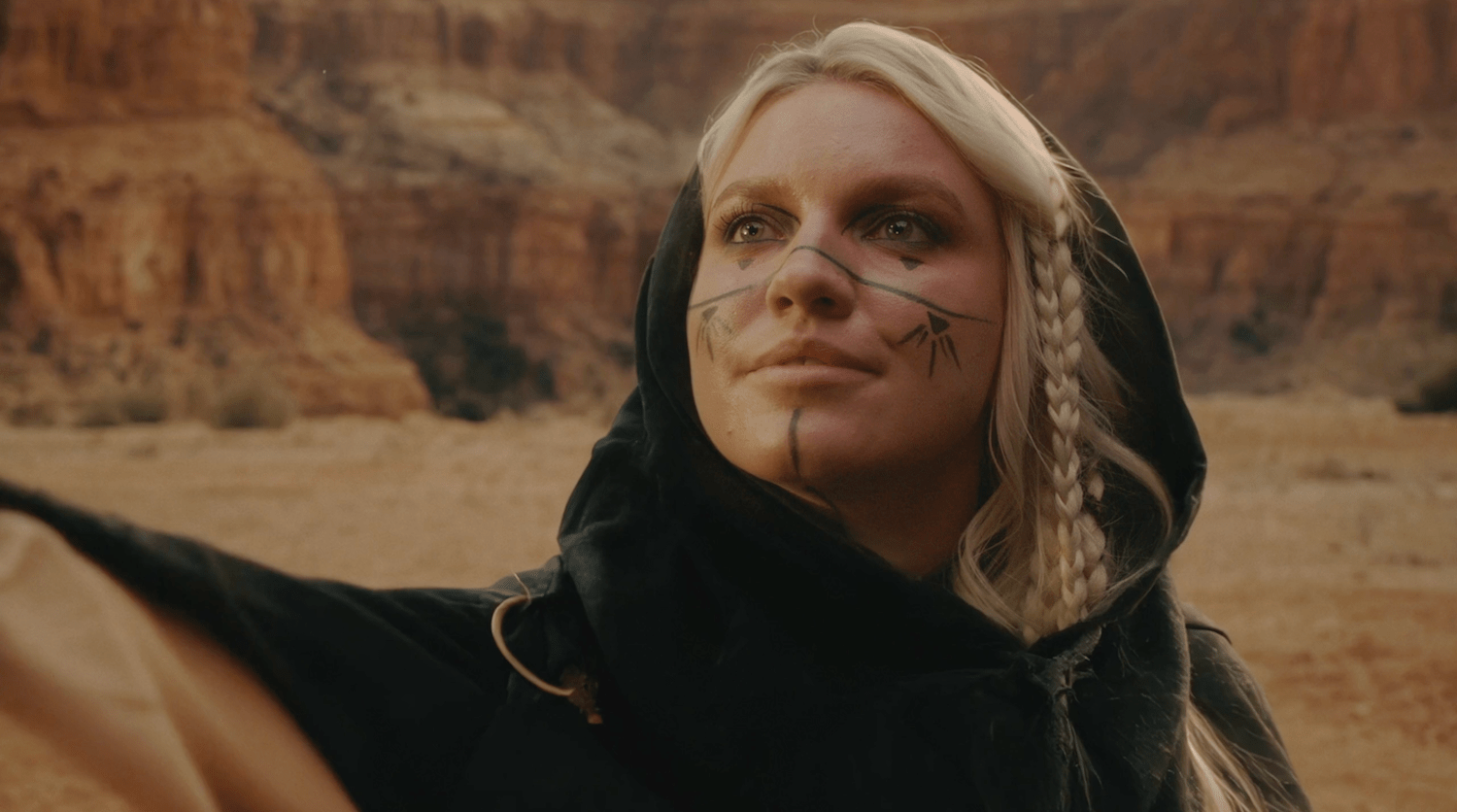
Hey Kelsie, thanks for taking the time to talk to us today. Could you tell us a little known fact about yourself?
Thanks for asking. Actually I will tell you two interesting facts. First, I have a pet pot-bellied pig, named Ozzie, after Ozzie Osborne. I got him when he was very tiny, but now he weighs 30 kilos and has long tusks. Second, when I traveled to Ukraine last year, the Special Forces taught me how to throw a grenade as a matter of survival when I was on the front line.
‘Dream of Peace’ has such an expansive, cinematic sound, so how did you design the structure to reflect the emotional shift from the current reality of conflict to a vision of eventual peace?
When I conceived my song “Dream of Peace,” I knew it had to be sonically and visually epic to reach the widest possible audience. Peace is such a powerful and universal concept that the song needed to connect with people on a deep and visceral level. I thought about songs that have brought people together across the globe, such as “Imagine” and “We Are The World,” and wanted to write something along those lines that would give people chills or bring them to tears. This was not an easy task. So lyrically, I used an interesting literary device called anaphora, which is the repetition of a word or phrase at the beginning of successive lines for a powerful effect. Churchill used it in his famous House of Commons speech on June 4th, 1940: “We shall fight in France, we shall fight on the seas and oceans, we shall fight with growing confidence and growing strength in the air…” In each section of the song, I use a different anaphora. Also, in the song, I transition from the personal, “I just want to make peace,” to the universal, “We just want to make peace,” which makes peace not just an individual wish but a global responsibility. Sonically, I started with almost a whisper, a prayer, and said, “It’s not the way, we ought to live, It’s not the way, we’re taught to be, It’s not the way, to treat ourselves, It’s not the way, so plain to see.” These are words that everyone can relate to. And with that, the musical journey begins with a slow build of added elements and intensity, such as choir and orchestra, a more powerful vocal, and stops along the way to catch one’s breath, until the glorious crescendo, and the final “make this dream come true” resolution. The use of real instruments adds the essential human touch. Of course, a team of world-class musicians, producers, and engineers nailed the production and arrangement.
Tell us about how filming the music video was also an act of defiance.
I live in Washington, DC, but I travel regularly to Ukraine. Several months ago, I was invited to Los Angeles to receive the United Nations Humanitarian Award and the St. George’s Royal Medal of Honor issued by King Charles. While at the ceremony, I was asked to participate in the 2025 International Peace Concert in Los Angeles, on September 21st, the International Day of Peace. This was serendipitous and precognitive because I had just finished recording the audio for “Dream of Peace.” I jumped at the chance and called my team in Kyiv and asked if I could film the video for the song in Ukraine. They invited me to come there in late August but warned me that Russia would most likely hit hard that week because of Ukrainian Independence Day on August 24th. And they were right. While I was there and during the filming, Russia attacked on two different days with more missiles and drones than at any time since February 2022. Martial law was in effect, air raid sirens were constantly blaring, and anti-aircraft batteries were destroying drones and missiles overhead. It was so loud that the ground and the windows shook. Despite all of this terror, the video team worked tirelessly, day and night to do the filming and ensure that it was ready for the peace concert. This was a heroic act of courage and defiance by everyone involved.
Do you think your dual identity as an Ukrainian-American finds its way into your songwriting?
Yes, there is no way I could write such powerful songs about the effects of the war on Ukrainians without having it in my blood and having traveled there since childhood. Moreover, my 21 year old cousin was killed by Russia last year so this war is very personal for me. I spent a week on the front recently and that profoundly affected me because I heard and can retell stories that are being left untold. Moreover, sometimes I include Ukrainian musical motifs in my songs that make them more interesting.
What message are you portraying through the symbol of the astronaut?
The astronaut in the Dream of Peace video has so many meanings but the main one is that an astronaut takes risks for the benefit of humanity, so in the video I discover an astronaut in a barren landscape devoid of life but my human touch brings it back to life and its swirls back in time and space to find a beautiful peaceful earth, and I discover that I am the astronaut. So I took the risk for humanity and I succeeded. But the “I” is a metaphor for everyone on Earth who is willing to take a risk for peace.
How important do you think it is to use music and art in general as a form of protest?
As I noted above, I was inspired by John Lennon who wrote “Imagine,” a song known and sung by billions of people who want to get along. When President Zelensky spoke at the Grammys, he asked all artists to use their music to fill the silence caused by death and war, and that speech inspired me. During the 1960s and 70s, music formed the basis for change and protest, and I am hopeful that a whole new generation of artists will use their music for progress and the common good.
What’s next for the project?
I have two big projects in the works. The first will launch later this month, and it is another music video I filmed in Ukraine called “Champ,” about a 16 year old female Ukrainian karate champion who refused to shake the hand or take a photo with her Russian competitor last December in Vienna. The video of her courageous and principled action went viral in Ukraine so I asked her to come to Kyiv and film a music video, which we did right after filming “Dream of Peace.” It is a very powerful song and video about Ukrainian resistance and honor. We are building a campaign around the video to raise significant funds to help children of Ukrainian soldiers participate in sports during the war, and well-known sports figures will promote the campaign. The second project is the release of my full-length movie about Ukrainian resistance and resilience which I filmed last year. It is an emotional powerhouse, with me traveling to Ukraine to find answers about the death of my cousin. Along the way, I spent a week at the front and interviewed so many interesting and important people. Four of my songs are in the soundtrack, including one called “Star” because I realized after my trip that every Ukrainian is a star in one way or another.
Follow Kelsie Kimberlin on Instagram.
 PURPLE MELON