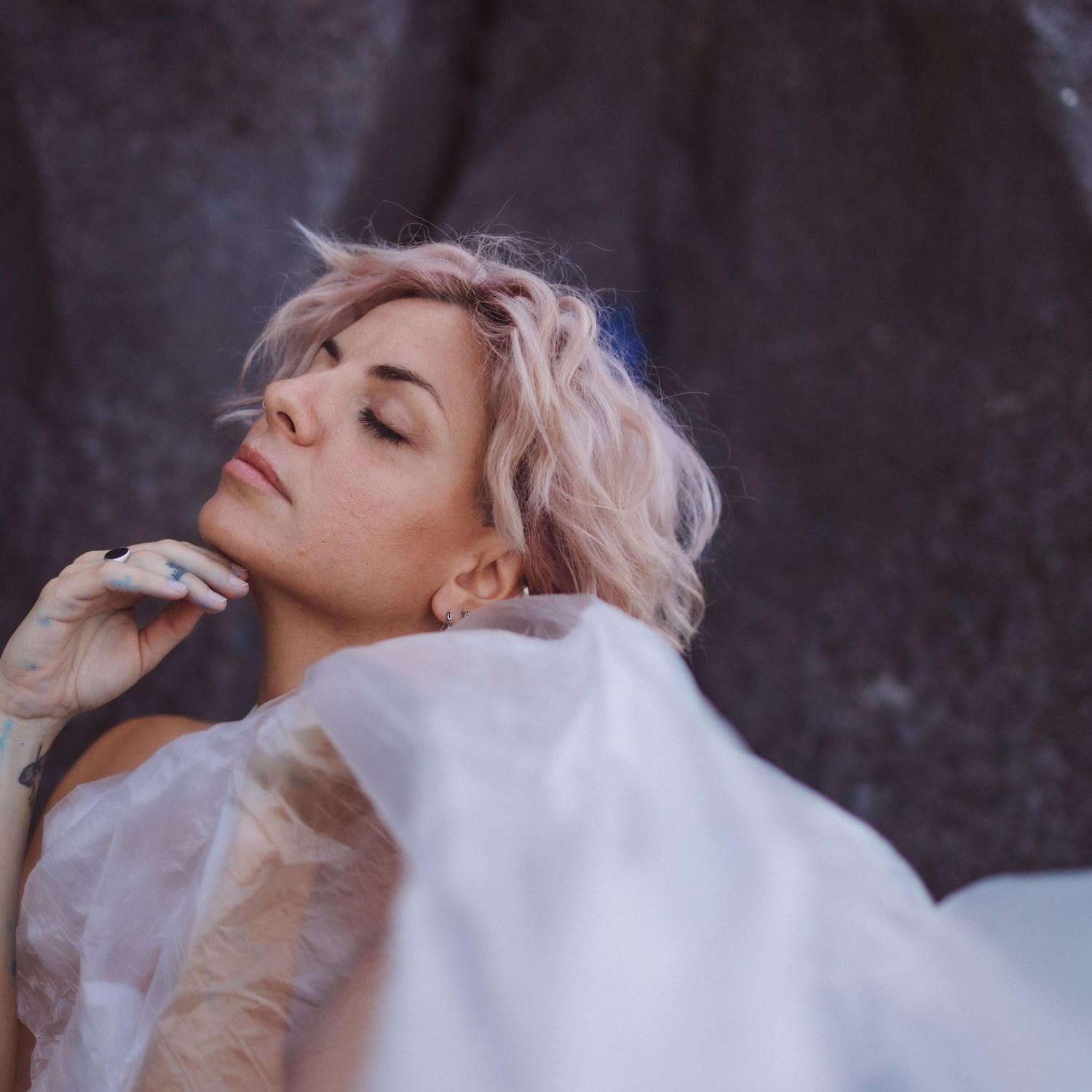
Hey BSP, thanks for taking the time to talk to us today. Could you tell us a little-known fact about yourself?
Happy to talk to you and share more about my story and work. A little-known fact about myself: I read about 15-20 books a year. I wish it were more; I love reading! I’m an insomniac, so a lot of my reading happens in the middle of the night. But my favourite place to read is actually on a plane. It’s strange because I’m genuinely terrified of flying, and yet I live in Madeira, which has one of the most notoriously difficult airports to land at in Europe. Reading is how I make peace with that fear; it’s my way of staying present instead of spiralling. So, I told you 3 little-known facts instead 🙂
Your new EP, All The Girls I Used To Be, recognises the ever-changing state of existence, so what inspired you to explore these different evolutions of the self?
I left Italy, my home country, fourteen years ago, and for a long time I had a difficult relationship with my birth name, Francesca. I was so angry at the world around me, and at my own problems, that I didn’t even tell people my real name for years. I always went by my nickname, Bri, which I love; it comes from my last name, but I’d genuinely get chills if someone called me Francesca. Now I’m finally making peace with her. We still bicker a little, though! 🙂 It took a lot of inner work to come back to peace with the reasons that pushed me so far from home. Through that process, I finally understood the value of who I used to be. There’s Francesca, who I started as, and then every obstacle, every struggle I moved through to become who I am now. It’s a cliché, but it’s true: without those versions of myself, I wouldn’t exist as I do today. Instead of denying those previous states, I’ve learned to accept them and carry their positive outcomes forward with me.
The EP is a map for navigating that. Across five songs, I explore what it means to lose familiar versions of yourself, question where you belong, and slowly rebuild an identity that feels true. Inspired by movement, nature, and the experience of living between cultures, each track captures a different stage of that journey, from fear and uncertainty to acceptance and belonging. It follows an emotional arc: Mirror faces the fear itself, that moment before a leap when doubt gets louder than intuition. Drip by Drip is about letting change happen gradually, the way water reshapes landscape one drop at a time. Silent, Yet Sound is about rebuilding identity after shedding the labels that no longer fit, realising silence isn’t emptiness; it’s where a more honest voice can finally show up. Distance is Home questions whether home is a place we leave or something we build inside ourselves as we move. And All the Girls I Used to Be closes it all by celebrating every version of me that got me here, not as something to outgrow, but as voices I carry forward. Rather than a collection of separate tracks, it’s a diary of change. The EP invites listeners to discover that home isn’t always a place; sometimes it’s the person you become along the way.
Do you think that your life moving between different languages and cultures has also impacted your self-perception? And how does this appear in your songwriting?
I speak Italian, my mother tongue, plus English, Portuguese, and Spanish. I’ve lived in Berlin, London, travelled constantly, and now I’m based in Madeira, Portugal. I write in mixed languages because I’m genuinely fascinated by how connected they all are; you find the same root words showing up across completely different cultures, echoes of old trade languages and migrations still living inside modern speech. It reminds you we’re all more connected than we think. But speaking a language also means stepping into a culture; every word carries a kind of physical, bodily memory that isn’t always visible when someone’s speaking in a foreign tongue.
I genuinely become a different person depending on which language I’m in. In English, I feel completely confident: it’s the language that set me free. I never had to ask permission to be an artist in English; nobody questioned it. I can talk about art for hours in that language. In Italian, I never had those conversations. When I speak Italian, I’m just Francesca, a family member and friend, and that’s it. In Portuguese, I’m still challenging myself: I started from zero four years ago, and I still feel like I’m discovering new ways of speaking, new words, even a new personality as I go. And in Spanish, I’m a party person. The energy shifts completely; the music in my head changes. It also connects back to my roots: my father was from Sicily, and so much Sicilian dialect still lives inside Spanish and Portuguese today, through Spain and Portugal’s deep historical ties to Sicily. I could talk about this for hours; I really love languages, and I’m writing more and more in mixed languages. Distance is Home has the chorus in Italian.
An integral part of your creative identity is your synesthesia, so how does that interaction between sound and colour shape your music?
My synesthesia activates within a certain range of frequencies, which is actually why I tend to sing in more or less the same vocal range, though lately I’ve been experimenting a lot more. It’s tied to the frequency of the notes themselves. Mirror is blue and lilac to me. I see it, and all the colours, really, as a kind of cloud expanding just behind my ears. Silent, Yet Sound is neon green, fast and bright, appearing in that same space. Across the whole EP, I mostly stay in a palette of blues, greens, lilacs, and pinks, soft, pastel tones. I rarely see red, orange, yellow, or black, because I don’t sing in that frequency range. Although I’ll admit, I can choose which colours I let myself see, so I do cheat a little 🙂
You collaborated with FREQUENCY33 on the EP, where your worlds of electronic innovation, personal healing and emotional transparency come together. What drew you to working together?
I met Noah (FREQUENCY33) because I wanted to expand my knowledge of Ableton. He’s a real magician with it. While we were working together, we started playing around with rhythms and notes, and at some point we realised we wanted to develop the collaboration into something more. I sent an early draft of one of the songs to my label and publisher (Pamela Pagano x Hitmint), and she loved it. That’s when we decided to properly commit to working together. It gave us the motivation to build a real story and create something new. Composing together has been remarkably easy. Sometimes we’d finish writing a track in a single day, then come back to it days later with fresh ears to work on the lyrics and finish it off. The whole process was smooth, and we had a lot of fun, but we also let ourselves be guided by emotional struggles and deep conversations. Talking things through mattered as much as the music itself. We wrote all the tracks at my place, looking out at the ocean. Noah lives and works in Germany now, but he’s always on the move, just like me. I’m really proud of what we made together.
What do you hope that listeners will take away from these songs?
I hope someone listening can feel a little less alone. Living far from your family, from familiar ground (emotionally and physically), is genuinely hard. You end up feeling torn in two, always. For me, leaving was never really a choice; it was survival. I needed to save myself. That’s a longer story I might tell another time, but I’m grateful I left, even though I love my family and where I come from. I was born in Rome and grew up between the city and the sea, in a small village in Sicily called San Martino, looking out at the Aeolian Islands with Etna behind me.
I hope people understand there’s always a way to live life on your own terms, even when it’s brutally hard. Even when you’re up against fear, uncertainty, rejection, no money, no support, judgment, scepticism, missing home, missing friends, missing love, daily challenges, and constantly questioning whether you made the right choice. But if you never try, you’ll never know. I want people to be able to travel through the music, from the first song to the last, and come out the other side feeling inspired and motivated. Honestly, I want that for myself too. I want to walk into the fire and come out scorched, but alive, and live the life I actually want without denying anything that happened to get me here. I’m not here to teach anyone anything. I just want to share, so someone out there might feel less alone. That’s what music is for me: a universal language where we find the things we have in common, which is what keeps us moving forward. We need that more than ever right now, in these dark times.
What’s next for the project?
As for what’s next. I’m renewing my live set. In September, I’m performing at Ars Electronica Festival, one of the most prestigious festivals in the world for art and technology, and it’s genuinely been a dream of mine. Through the Art for Change project, in collaboration with MDW Vienna [the University of Music and Performing Arts Vienna], I’ll be bringing a performance about climate change to the stage, a subject I care deeply about. Lately my research has taken me into the practice of ‘daylighting’. It means bringing buried rivers back to the surface, as a metaphor. It led me to a question about powerlessness, as something produced through invisibility, neglect, and silence. Also, I’m experimenting with a producer from Liverpool; I’m excited to see where this can go.
Follow BSP on Instagram.

