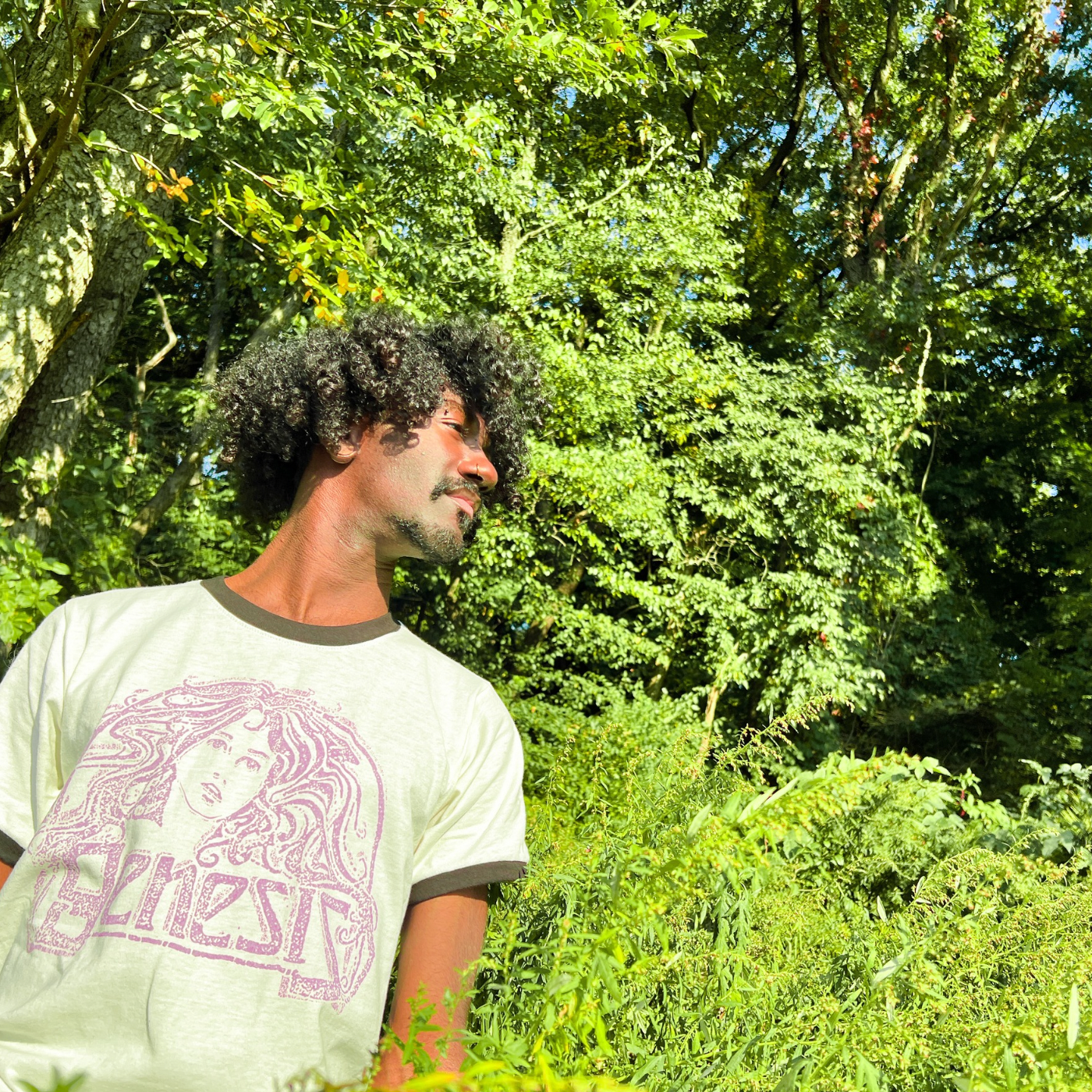
Hey BRIEL, thanks for taking the time to talk to us today. Could you tell us a little known fact about yourself?
Thank you so much for having me — it really means a lot. Something people might not know is that, in my personal life as Gabriel, I’m actually pretty chill. I’m an ambivert, so while I love going out, being social, and spending time with my friends, I also really value my peace. I like winding down at home with my man, throwing on some YouTube, and vibing out on the couch with some Buffalo Ranch Pizza. That’s my recharge zone.
But when I step into BRIEL the Artist, it’s a whole other energy. I walk into a room and you feel me — I’m loud, proud, expressive, and fully present. I thrive in performance, in connection, in taking up space as a queer Black artist. That’s where the fire lives.
As far as accomplishments go, I’ve had the honor of performing at the Apollo Theater in 2023, twice at the Brooklyn Museum, and I created my own concert series called The Coming of the Year Sessions — a platform I built to spotlight other artists and bring community to the forefront.
You just released your debut mixtape, DAMN GENESIS, which you describe as “the death of who I was told to be, and the birth of who I truly am”. What was the emotional or creative spark that first set this project in motion?
Creating DAMN GENESIS became an outlet for me to be, say, and do anything I wanted. I didn’t have to be anyone else in my music — it was honest in my words, and I didn’t allow limitations or restrictions to hold me back.
Even with how explicit DAMN GENESIS is, I had open conversations with my team about expression in music and profanity. I acknowledge that it’s not always necessary, but to me, it’s true — it’s honest to who I am. When I’m with my homegirls, I cuss up a storm, and I’d rather admit that than pretend I don’t. The death of who I was told to be would’ve restricted me from using the language I naturally use to express myself — from fully being in my Blackness, my queerness, and my personality.
But in the birth of who I truly am, I’m able to express myself in music that feels authentic — to be unapologetically Black as hell, gay as hell, and playful as hell. Over the course of making all of these songs, I felt more and more of my truth coming out through the experiences I was unpacking. And when I finally wrapped up the project, I felt like I had unleashed everything I truly wanted to say.
You also mentioned the mixtape is “violent in how complete it is”. Can you unpack that a bit, like what did you have to leave behind or destroy to create this new beginning?
I had to leave behind all of the fakeness that I had. The fakeness that I gave to myself — in the beginning stage of my career, I wasn’t making the music I truly wanted to make. I was unconfident, insecure within myself. Even when I had the opportunity to touch the legendary stage at the Apollo Theater, I’ll always remember during soundcheck — I was singing a trap hip-hop R&B song I made, and I was stiff and shaky in my voice. The director of the show walked up to me and asked, “Who are you singing to?” which, in the moment, felt condescending and disrespectful — because I was doing my best, but it wasn’t enough.
Over time, throughout that year of 2023, I had to dig deep into who I was as an artist and who I was “singing to.” I didn’t have an identity, a voice, a story.
I used 2024 to go on hiatus and privately work on DAMN GENESIS, and over the course of the songs, I kept unlocking the confidence in my voice. I started to know who I was singing to — to the vulnerable, just like me. Each song is where I became vulnerable and told a story ’til the end.
“In how violent, in how complete it is” became real when I made ‘PRETTY’ — a message to myself about wanting to feel beautiful. In other words, “pretty.” That was my longest and most insufferable insecurity, and it took years and years of therapy to face that. For me to put it in a song, to release it, to admit it publicly to the internet — that was violent to the demons that fed off of that insecurity. The demon that didn’t want me to admit it publicly — because to do so meant I could either be praised for sharing or broken down
for it. I killed that demon.
That’s why “weaponize demons for your protection / it’s worth a lesson” is such an important line off the entire mixtape — because those demons are the parts of you that were once destructive: trauma, anger, shame, addiction, heartbreak, rejection. Weaponizing them is you not letting them control you, but instead using the lessons, the strength, the edge you gained from surviving them. And “for your protection” means turning those past hardships into armor or tools that keep you safe, aware, or strong in the present. I turned what haunted me into something that shields me.
I used to run from my demons. Now, I’ve learned how to aim them. Every time I speak my truth — even the darkest parts of it — they fight for me.
One of the standout tracks ‘SITUATIONSHIP’ grapples with walking away from emotionally unavailable love. What was the hardest truth you had to face while writing or recording that song?
One of the hardest truths I had to face while writing this song was realizing the grass isn’t always greener on the other side. You can crave love from someone, yearn for it even — but if they’re not giving you what you need to grow and thrive, it’s not worth holding onto. It’s not worth sacrificing your peace or mental health for someone who can’t love you the way you deserve.
Sometimes, the most powerful thing you can do is walk away. Saying “no,” choosing yourself, being alone — those can be more fulfilling than abandoning your peace for a version of love that only looks better. That’s the illusion: the grass might look greener, but a lot of times it’s artificial. Meanwhile, you’ve been watering your own grass for years. Don’t throw that away for someone who’s unsure or withholding. I really believe people know what they want — they just avoid saying it, because the truth gives the other person power. And if you give someone the power to walk away, you have to be ready to let them go.
Recording this song came easy because I’ve been on both sides of a situationship. I’ve been the one with my heart broken — ready to give everything to someone who wouldn’t budge. And I’ve also been the one who caused the heartbreak — when someone wanted more from me than I was ready or able to give. Both sides come with confusion, emotional chaos, and pain.
When I was the one causing harm, I had to own that I was insecure, selfish, manipulative. I gaslit. I wasn’t someone who deserved the trust I was being given. That truth was hard to face — but it was necessary.
That’s why in the song, I speak from both sides. It helped me not only process my own pain, but acknowledge the pain I’ve caused. The deep voice effect in SITUATIONSHIP represents that — another version of me. The other side of the story. The person I used to be.
‘PRETTY’ asks powerful questions around masculinity and softness, particularly for Black men. How did it feel to write from that level of vulnerability? Did anything surprise you during the process?
‘PRETTY’ was a song that needed to exist, especially in a mainstream music industry where Black men are often forced to be hypermasculine just to be taken seriously. Any expression that even feels “gay” or outside of society’s narrow box strips us of our worth — and excuse my language, but it’s fucked up. Artists like me have to work ten times harder just to be acknowledged, to even be let in the same room as “The Man.”
I’ve had to wrestle with my own insecurities about gender expression. I used to make sure I never showed any femininity because I was taught it wasn’t attractive — that it was weakness. Femininity is only respected when it’s coming from women, and that’s just not true.
‘PRETTY’ wasn’t just a moment for me to be vulnerable. It was a message to all men: you’re allowed to be soft. Your sexuality doesn’t define your emotions. Men feel pain. We get sad. We want to be held, to be loved — and none of that makes you any less of a man or changes your sexuality. But society teaches us we’re not supposed to feel those things, and when we do, we hide them out of shame. Men suffer in silence, and toxic masculinity runs deep.
I made a song for the women with ‘LADIES SONG’, but I felt there also needed to be one for the men. When I recorded ‘PRETTY’, I connected with it deeply as a man. I shared my own pain and hoped to inspire more men to speak on what they’re going through — because things are starting to shift, even if just slightly. I opened up about colorism too — how dark-skinned men are often made to feel less beautiful. I wanted to name experiences that are usually brushed off as “women’s issues” and say: No. We all go through this. We’re all human.
This mixtape tackles love, faith, identity, and self-worth, often all at once. How do you navigate that emotional complexity without getting lost in it?
It’s ironic that you ask that, because in this cycle of life? You do get lost in it. There’s no ifs, ands, or buts about it—it just happens. But the first thing you learn is how to find balance for yourself. That became true for me while recording my debut mixtape. A lot of the songs center around relationships—falling head over heels, the honeymoon phase turning into verbal abuse, infidelity, constant back-and-forth. But while relationships are a core theme, they’re not the full foundation. The real root of the project is self-worth.
If you ask, “Why are you staying in these relationships?” or “Why are you accepting this behavior?”—that takes you deeper, into the emotional and spiritual reasons behind those choices. That’s where themes of faith show up too. Like, “Why do you feel the need to speak so raunchy?” or “Why do you feel free enough to damn God?” Those aren’t just shock questions—they uncover something wider, something more complex that defines DAMN GENESIS.
So the balance comes from letting all these layers coexist. It’s not that everything happens at once—it’s that everything is connected. The emotional complexity isn’t meant to be sorted neatly, it’s meant to be felt, explored, and understood piece by piece.
As a gay Black artist from the Bronx, how do you hope DAMN GENESIS contributes to the conversation around queerness, masculinity, and mental health in music?
I hope more Black queer men start stepping into their vulnerability—sharing their stories, their truths, and how it actually felt going through what they’ve been through. A lot of us have seen and survived things that rarely get talked about. I know there are men out here who’ve had it even harder than I have. But I believe when we use our outlet—whether it’s music, art, or something else—that pain can transform into something beautiful. Because while we’re not defined by our experiences, they do shape who we are. And I think it’s time we reclaim that instead of running from it.
There’s a line in ‘PRETTY’ that says, “weaponize demons for your protection / it’s worth a lesson.” That bar means everything to me. The “demon” is whatever tries to hold you back—whether that’s trauma, shame, fear, or doubt. And to weaponize it means using that same thing to protect yourself, to grow, to move forward. You’re not hiding from it—you’re using it. That kind of power only comes when you stop resisting your experience and start understanding it.
With DAMN GENESIS, I wanted to start a new conversation—not just about queerness or masculinity, but about the real struggle of living with faith in a world that constantly pulls you away from it. As someone who believes in God but also exists in a very worldly environment, I don’t think that duality gets talked about enough. You’re either labeled a “Christian artist” or a “worldly artist,” and there’s no space for the in-between—for the everyday walk, the slip-ups, the questions, the growth.
I want to live in that space. I want to make room for more artists who are navigating life, love, identity, and God all at once. DAMN GENESIS is the beginning of that for me. It’s not just a mixtape—it’s a statement. I’m here.
Follow BRIEL the Artist on Instagram.
 PURPLE MELON