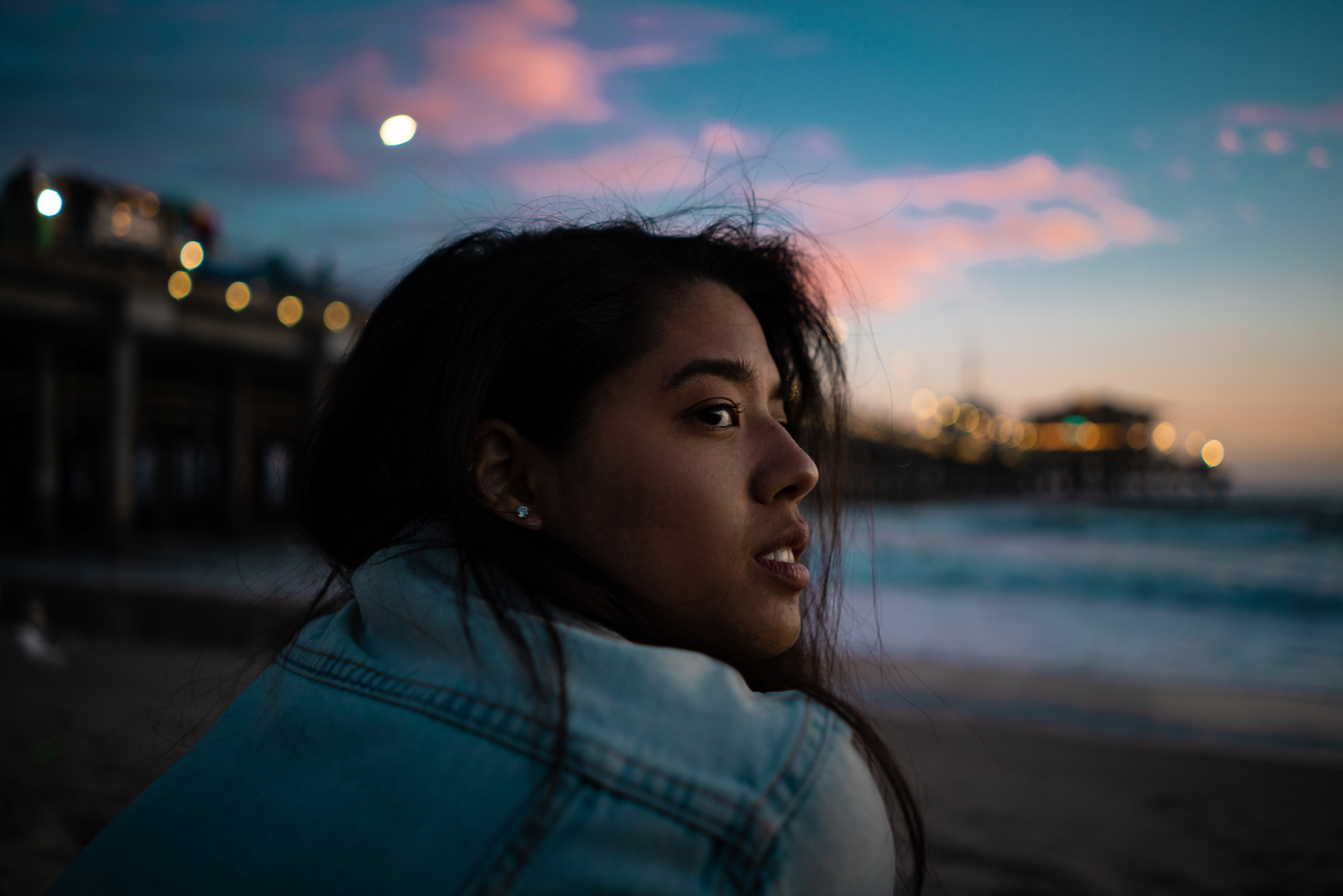
Hey Alina, thanks for taking the time to talk to us today. Could you tell us a little known fact about yourself?
I never really know how to answer these kinds of questions — I mean, once it’s known, it’s no longer little-known, right? But if I had to share something, I’d say I have a cub named Kona. She’s a big part of my world, and if you haven’t spotted her yet, you probably will soon — she pops up everywhere: at my shows, in the background of my live videos, and maybe even on some cover art… spoiler alert.
Your new single ‘Shoebox’ feels incredibly personal. Can you tell us about the moment or experience that sparked the idea for the song?
‘Shoebox’ came to life in January 2014, during a period where loss and grief felt almost surreal. I remember feeling like memory itself was an enemy — it was easier to pretend the past hadn’t unfolded the way it had. But in a moment, sitting in a dimly lit room, just me and my guitar, catharsis happened. I realized that in the midst of that emotional chaos, there was a story that felt true. It was a story about remembering — not just the pain, but the false hope, the healing, and ultimately, the peace that comes only through acceptance. I’ve performed ‘Shoebox’ countless times now, but each time I play it, I feel it binding that place where distance was placed between the past and present. It serves as a reminder: the only real moment we have is the present, and it’s worth feeling it all, with honor for everything that’s come before.
How did grief shape the songwriting and production process of this track?
The grief I was feeling when I wrote the track wasn’t something we tried to necessarily recreate, but more of a feeling we allowed to guide us. Working with Jake Stentiford, my close friend and long-time guitarist, we explored different tones and textures , layering sounds with our pedalboards to find something that felt right. It was almost like the grief became a presence in the track itself. When we found that initial tone, we knew we had captured something that could carry the emotion of the song throughout, and from there, everything else fell into place. That intro, in particular, became the undercurrent for the entire production — it’s almost like the grief was woven into the song’s DNA, and it shaped the way we approached everything that came after.
You self-produced and arranged ‘Shoebox’, so how did you approach crafting its acoustic, ambient soundscape?
For me, this record began with the simplest intention: to capture each song in its purest form, before anything else. The moment I tracked the first layers of ‘Shoebox,’ the rawness and clarity of the emotion behind the song was there. After that, it wasn’t about adding things for the sake of it — it was about honoring the initial feeling and letting the production grow organically around it. The soundscapes had to preserve that clarity, while also expanding on the emotional depth. I wanted the space to feel intimate and open at the same time, as if the song were evolving in real-time with the listener. It’s a balance of simplicity and complexity, where each sound serves a purpose.
This is also the title-track for your album, so how does it set the tone for the record?
‘Shoebox’ really sets the tone for the album because it represents both the raw, stripped-back beginnings of my writing process and the production that builds on that. The themes of love and loss, and the internal journey that comes with it, are central to the record, and ‘Shoebox’ encapsulates both serving as a bridge between the vulnerability of the early ideas and the fuller, more expansive sound of the album. The song speaks to both the struggle and the serenity that comes from facing life’s challenges, and I think that balance carries through the whole record.
If ‘Shoebox’ had to leave one lingering feeling with listeners, what would you hope that is?
I would hope that ‘Shoebox’ leaves listeners with a sense of bittersweet peace. It’s the kind of peace that comes from acceptance — but, like everything in life, it’s not without its cost. When we accept things as they are, there’s a certain kind of peace, but it’s often wrapped in loss or change. For me, that’s what the song is about: finding that delicate balance between holding on and letting go. It’s not necessarily about resolution — it’s about embracing the journey, with all of its complexities.
What’s next for Alina Ly?
I’ve got a lot of music coming up that I’m really excited to share. There’s been a lot of work and waiting, but I’m finally rolling out singles leading up to my debut album in November, and I’ll be doing a headline UK show around the release. I’ve also already started working on my second album, which feels like a natural evolution of where I’m at both musically and emotionally. There’s a lot in store, and I can’t wait to take people on this next chapter with me.
Follow Alina Ly on Instagram.
 PURPLE MELON